
Is Tasks.Bot Good for Report Generation Automation Software?
Your team already runs on WhatsApp, so why is report generation still stuck in spreadsheets? Field staff send voice notes and photos all day, yet managers rebuild the same daily summary by hand each evening.
This article answers whether Tasks.Bot handles report generation automation well, covering how instant reports work inside WhatsApp, where its reporting fits and where it currently falls short, plus pricing, beta status, and security. By the end, you will know whether Tasks.Bot suits your team or whether you should keep looking.
What Is Tasks.Bot? A WhatsApp-Native Task Management Platform
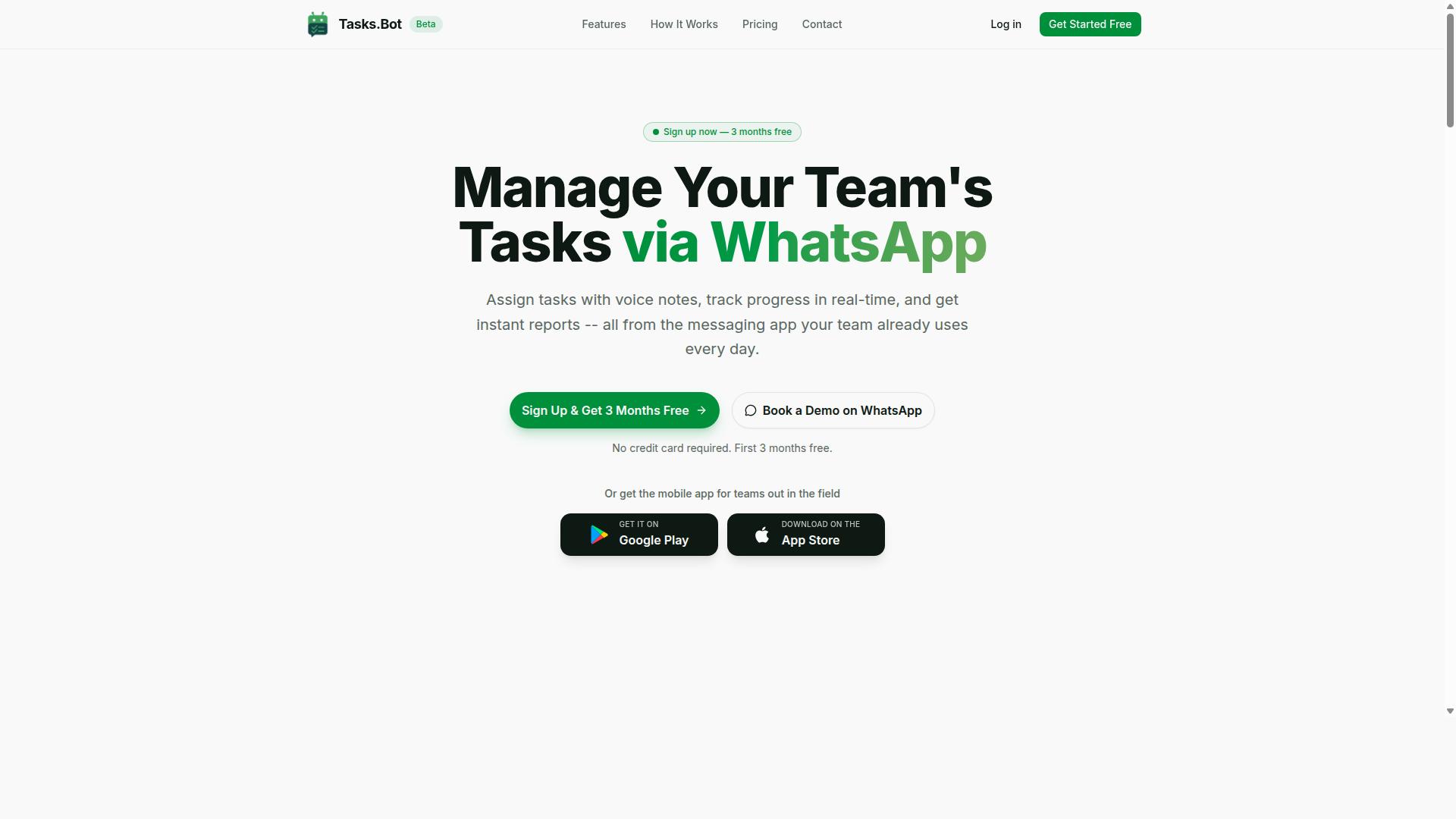
Tasks.Bot is a task management platform that operates entirely within WhatsApp, allowing teams to assign tasks, track progress, and receive reports without leaving the messaging app. It is a SaaS tool built around the messaging app that field and remote teams already use every day.
The core appeal is simplicity. Team members do not need to install new software or create separate accounts, which removes the biggest barrier to adoption for workflow automation in teams that are not desk-based.
Tasks.Bot is available through WhatsApp and also offers a mobile app for field teams. The service is currently in beta and includes a free trial period.
Who Tasks.Bot Serves: WhatsApp-First Teams and Field Staff
Tasks.Bot is designed for teams that already use WhatsApp as their primary communication tool, especially those with field staff who need to manage tasks, track attendance, and log hours. For these teams, the app is not a new destination, it is the place work already happens.
That matters because field and remote workers often juggle several disconnected tools. A chat app for updates, a spreadsheet for attendance, and a separate system for hours. Tasks.Bot pulls task management, attendance tracking, and payroll-ready hours into one familiar thread.
The pain points it addresses are practical:
- Tasks assigned in chat get lost in long message threads
- Attendance for off-site staff is hard to verify
- Hours logged on paper are slow to convert into payroll data
- Managers lack a single view of what field teams completed
By keeping all of this inside WhatsApp, Tasks.Bot lowers the training burden. Staff respond to a message the same way they already do, and managers get structured updates instead of scattered replies. The site mentions that hundreds of teams are already using the service.
This WhatsApp-first model also sets the stage for reporting. When tasks, attendance, and hours flow through one channel, the data needed for report generation automation is captured as work happens rather than reconstructed later. That foundation shapes how Tasks.Bot fits into automated reporting and business intelligence workflows, which the following sections explore.
Is Tasks.Bot Good for Report Generation Automation? The Direct Answer
Yes, Tasks.Bot is effective for report generation automation, but with specific strengths and limitations that teams should understand before adopting it.
Tasks.Bot is a task management platform built around WhatsApp. It handles voice note task creation, automatic task assignment, smart deadline reminders, approvals and automations, instant reports, tasks on a map, a live day tracker, face-verified attendance, and shifts, leave, and hours management. Its core promise is simple: run work where your team already communicates.
For report generation automation, that design choice shapes everything. Tasks.Bot produces instant reports covering task status, attendance, and performance metrics, delivered right inside the chat. Managers do not log into a separate portal or wait for a scheduled email to land. They ask, and the report appears.
Where Tasks.Bot falls short is the deep end of analytics. It is not a full-scale business intelligence reporting platform. There is no native custom report builder for complex queries, and no database connectors for pulling in outside data sources. Teams that need multi-source dashboards, advanced data visualization, or heavy chart generation will likely pair Tasks.Bot with a dedicated BI tool.
The honest verdict: Tasks.Bot is a strong fit for operational reporting in the flow of daily work. It is a weaker fit for enterprise-grade data reporting. The sections below break down exactly how instant reports work and where the boundaries sit.
How Instant Reports Work Inside WhatsApp
Tasks.Bot generates instant reports directly within WhatsApp, allowing users to request and receive updates on task progress, attendance, and performance without switching apps.
The mechanics are deliberately lightweight. A user can trigger a report on demand, or rely on automated schedules to push recurring reports at set times. Because Tasks.Bot uses AI to understand user intent and create tasks from messages, the same conversational layer drives reporting requests. There is no separate reporting module to learn.
The report types map to the platform's core features:
- Task status reports, covering assignment, progress, approvals, and deadlines
- Attendance summaries, drawing on face-verified attendance and the live day tracker
- Performance metrics, reflecting task completion and hours logged through shifts, leave, and hours management
Reports arrive as messages or files inside the chat, so they can be read, forwarded, or exported and shared with people who are not in the group. For a manager moving between sites, that means real-time data access from a phone, with no laptop and no login required.
This is automated report delivery in its most practical form. The value is not analytical depth. It is speed and reach. A supervisor can check whether morning tasks were completed before the shift ends, and act on the gap the same day rather than reading about it in a weekly summary.
Where Tasks.Bot's Reporting Fits Best - and Its Current Limits
Tasks.Bot's reporting shines for operational teams needing quick, in-the-field updates, but it currently lacks advanced data integration and customization features found in dedicated BI platforms.
Ideal use cases cluster around daily execution. Task tracking reports show what was assigned, what was approved, and what is overdue. Attendance monitoring draws on face-verified attendance and the live day tracker. Simple performance dashboards, built from task completion and hours data, give managers a working KPI tracking view without a separate tool.
Teams with field staff, shift workers, or distributed crews tend to get the most from this model. Reporting happens where the work happens, which removes the usual gap between doing a task and recording it.
The limits are worth stating plainly:
- No native database connectors or API connectivity for pulling in external systems
- Limited custom report builder for bespoke layouts or calculated fields
- WhatsApp as the primary interface, which constrains complex data visualization and chart generation
Practical workarounds exist. Exporting data to Google Sheets, or moving it into a dedicated business intelligence reporting tool, lets teams handle deeper analysis while keeping Tasks.Bot as the front line for capture and delivery. Used that way, it functions as a fast operational layer rather than a replacement for a full analytics stack.
For most operational teams, that division of labor is the right one. Tasks.Bot covers the daily reporting need well, and its native WhatsApp integration, Android and iOS apps with push notifications, voice capture, and a home screen widget keep the data flowing in without friction.
Report Generation Features That Set Tasks.Bot Apart
Tasks.Bot differentiates itself through AI-powered task creation, voice note inputs, and face-verified attendance, which feed directly into its reporting engine. Instead of asking teams to log data in a separate system, the platform captures work as it happens inside WhatsApp.
The live day tracker records progress and time as tasks move forward, while GPS tracking and payroll-ready hours round out the picture for field and shift-based teams. Each of these inputs strengthens the accuracy and timeliness of report generation automation.
Because Tasks.Bot operates entirely within WhatsApp, team members do not need to install anything or create new accounts. That low barrier to entry means the data feeding reports is more likely to be complete and current.
Voice Notes, AI Task Creation, and Live Day Tracker as Report Inputs
Tasks.Bot uses AI to convert natural language and voice notes into structured tasks, while the live day tracker logs activities, providing data for automated reports. This removes the manual entry that typically slows down data reporting tools.
A field worker can send a voice note describing a job, and the platform turns that message into a task with the relevant details attached. There is no form to fill in and no separate app to open, which keeps the process fast and natural.
From there, the live day tracker records task progress and time spent. Completion times, status changes, and activity history all accumulate as structured data rather than scattered notes.
That data feeds directly into reports, enabling KPI tracking and performance metrics without extra effort. Managers see what was planned, what was completed, and how long each item took, all drawn from the same source.
Because the AI understands user intent and creates tasks from messages, the reporting engine works with cleaner inputs. Fewer gaps and less guesswork mean the resulting performance metrics reflect actual work rather than approximations.
Face-Verified Attendance, GPS Tracking, and Payroll-Ready Hours Data
Tasks.Bot captures attendance with face verification and GPS tracking, automatically calculating payroll-ready hours that can be included in reports. This addresses two common weak points in workforce reporting: proving who was present and confirming where the work happened.
Face verification ensures that attendance records reflect the actual person on shift, reducing the risk of buddy punching or inaccurate clock-ins. For field staff, GPS tracking validates location alongside the time entry, so records carry both a who and a where.
Together, these features generate reliable hours data that flows into reports used for payroll and compliance. Because the platform also handles shifts, leave, and hours management, the numbers stay consistent across attendance and reporting views.
This data is available in real time, so supervisors can review attendance and hours as the day unfolds rather than waiting for a manual reconciliation at the end of a pay period. Reports built on this foundation support payroll processing and compliance checks with far less back-and-forth.
For teams that need to move the data elsewhere, the hours information can be included in reports and exported for payroll systems. That keeps Tasks.Bot useful as a source of truth while still fitting into existing payroll workflows, and enterprise-grade encryption protects the underlying task and conversation data throughout.
Pricing: What Report Automation Costs with Tasks.Bot
Tasks.Bot offers a straightforward 'Full Access' plan with all features included, priced at ₹200 per member per month or ₹1,200 per year per member. There are no tiers, no gated modules, and no upsells buried behind a premium package. For anyone evaluating report generation automation, that flat structure removes a common frustration: wondering whether the reporting features you actually need sit in a higher bracket.
Pricing is available in Indian Rupees and US Dollars, and the site includes a 'Select currency' option so buyers can confirm which currency applies before purchasing. That matters for teams comparing automated reporting software across regions, since exchange handling and billing clarity often complicate software decisions.
Because the plan is priced per member, cost scales with team size rather than with usage. A small team pays for a small team. A larger department pays proportionally more, but every member gets the same full feature set, including report generation. There is no penalty for adding a viewer or a stakeholder who only needs to see recurring reports.
| Plan | Price | Billing |
|---|---|---|
| Full Access (monthly) | ₹200 per member per month | Billed monthly |
| Full Access (annual) | ₹1,200 per year per member | Billed yearly, save 50% |
The annual option saves ₹1,200 per member per year, effectively cutting the monthly rate in half. For a team of five, that difference adds up quickly, and it is the kind of saving that makes an annual commitment worth considering once a workflow is proven.
New users also get 3 months free, with no credit card required and the ability to cancel anytime. That combination lowers the risk of evaluating report scheduling, automated report delivery, and dashboard automation before committing budget. A refund policy exists as well, which gives additional reassurance if the fit is not right.
For teams weighing report generation automation against per-seat alternatives, the math is simple to model. Multiply the member count by the monthly or annual rate, compare that against the value of time saved on recurring reports, and the full-access approach becomes easy to justify. There are no hidden feature gates to factor in.
Trust and Track Record: Beta Status, Security, and Refund Policy
Tasks.Bot is currently in beta, which means the platform is still evolving, but it already implements security measures and offers a refund policy to mitigate risk. For anyone weighing report generation automation, that combination matters. It signals a product confident enough to stand behind its service while still being honest about its stage of development.
Beta status is often misunderstood. It does not mean unfinished or unreliable. In practice, it means the team is actively refining features, and that features may change as the product matures. For early adopters, this is an opportunity rather than a drawback. Feedback from real users can directly influence how the platform develops, which is rare once a tool is locked into a fixed release cycle.
Security is a reasonable concern for any business intelligence reporting tool, since reports often carry sensitive operational and financial data. Tasks.Bot addresses this with face verification and enterprise-grade encryption. Face verification adds a layer of identity confirmation, while encryption protects task and conversation data. Together, these measures help reduce the risk of unauthorized access during automated report delivery.
The refund policy, listed in the site footer, is another signal of confidence. A vendor willing to offer refunds is essentially saying it expects users to be satisfied. For teams evaluating automated reporting software, that policy lowers the cost of trying the platform and reduces the pressure of a long-term commitment.
Real-world validation matters too. Hundreds of teams are already using Tasks.Bot, which suggests the platform is not just theoretical. Those users are running report scheduling, recurring reports, and automated report delivery in live environments. That kind of adoption provides practical evidence that the tool works beyond a demo.
- Beta stage: features may change, but early users help shape the roadmap
- Security: face verification and enterprise-grade encryption
- Refund policy: listed in the footer, reducing buyer risk
- Adoption: hundreds of teams already using the platform
For a report generation automation tool, trust is built on transparency. Tasks.Bot is upfront about being in beta, names its security measures, and offers a refund path. Combined with an active user base, that is a credible foundation. The platform also offers a Book a Demo on WhatsApp option, giving prospective users a direct way to ask questions before committing.
In short, the beta label is not a warning sign here. It reflects an evolving product with real safeguards, a refund policy, and a growing community of teams relying on it for workflow automation and KPI tracking. That is a reasonable level of trust for a platform at this stage.
Who Should Choose Tasks.Bot for Report Automation
Tasks.Bot is ideal for WhatsApp-centric teams with field staff who need automated reports on tasks, attendance, and hours without adopting complex software. The platform is built for teams that already run their day-to-day communication through WhatsApp and want reporting to happen in the same place, rather than in a separate analytics tool nobody opens.
The site notes that hundreds of teams already use the service. That tells you the product is aimed at a practical, everyday audience rather than data analysts or enterprise BI departments.
Below are the profiles that get the most value from Tasks.Bot as a report generation automation tool, plus a note on when a different category of software makes more sense.
- Small and medium businesses. Teams without a dedicated analyst benefit from reports that arrive without manual spreadsheet work.
- Field service teams. Staff working on-site need task, attendance, and hours tracking that does not depend on desk-based software.
- Remote teams using WhatsApp. Reporting stays inside the messaging app the team already uses every day.
- Managers who need real-time operational reports. Supervisors get visibility into tasks, attendance, and hours without chasing updates.
Why these groups benefit comes down to three things. First, no training required: if your team can use WhatsApp, they can work with Tasks.Bot. Second, instant reports on tasks and attendance mean managers do not wait for a weekly compile. Third, attendance and payroll-ready hours live in the same system, so the numbers used for reporting match the numbers used for pay.
That combination removes a common pain point. Many small teams stitch together a chat app, a spreadsheet, and a separate time tracker, then spend hours reconciling them. Tasks.Bot collapses that into one flow, which is the core appeal of a task automation platform aimed at non-technical users.
It is fair to say Tasks.Bot is not built for every reporting need. Teams that require deep business intelligence reporting may want more. Consider a different tool if you need:
- Complex data modeling across many external sources
- Advanced data visualization with custom chart generation
- Warehouse-level database connectors and heavy API connectivity
- Analyst-grade dashboards with dozens of customizable KPIs
Those are legitimate needs, and general BI platforms serve them well. But they also come with setup time, licensing costs, and a learning curve that many field and small-business teams never clear. A tool that goes unused produces no reports at all.
The honest way to frame the choice: pick Tasks.Bot when your reporting questions are operational. Who worked today? Which tasks are done? How many hours are owed? Pick a broader BI suite when your questions are strategic and span many disconnected systems.
For the audience Tasks.Bot targets, the verdict is straightforward. If your team lives in WhatsApp and your reporting needs center on tasks, attendance, and hours, Tasks.Bot is a strong fit. It delivers automated reporting where the work actually happens, with no training barrier and no separate system for staff to ignore.
Final Verdict: Is Tasks.Bot Worth It for Report Generation?
For teams already using WhatsApp, Tasks.Bot is a cost-effective and efficient solution for report generation automation, despite its beta status and limited advanced analytics. The platform fits a specific but very common need: turning routine operational updates into structured, shareable reports without adding another dashboard nobody opens.
Its biggest strength is that it lives where your team already works. Instead of asking people to log into a separate portal, Tasks.Bot uses WhatsApp integration to collect inputs and deliver finished reports. That single design choice removes most of the friction that kills internal reporting adoption.
AI-powered inputs and instant report delivery round out the core value. Users describe what they need in plain language, and the system produces the output quickly, which suits daily standups, shift summaries, and recurring status updates. For a task automation platform rather than a full BI suite, that speed is the point.
Pricing is another clear plus. Tasks.Bot is positioned as an affordable option, which matters for small teams that need recurring reports but cannot justify enterprise business intelligence spending. Low cost plus low setup effort is a rare combination in automated reporting software.
Now the honest limitations. Tasks.Bot is still in beta, so features and reliability may shift over time. Its reporting is also basic compared to dedicated BI tools: if you need deep data integration, API connectivity, database connectors, or warehouse-level cloud reporting, this is not the platform for that job.
So who should choose it? The recommendation is straightforward.
- Good fit: WhatsApp-first teams that want fast, low-cost operational reporting and simple workflow automation.
- Good fit: Small businesses replacing manual copy-paste reporting with scheduled, automated report delivery.
- Poor fit: Analysts needing advanced dashboard automation, KPI tracking across many sources, or heavy data visualization and chart generation.
- Poor fit: Organizations requiring extensive Excel reports, CSV output pipelines, or enterprise-grade BI infrastructure.
If your reporting needs are operational and your communication already happens on WhatsApp, Tasks.Bot is worth adopting now. If your needs are analytical and data-heavy, treat it as a lightweight companion rather than a replacement for a full BI stack.
To book a demo or get started, reach the team directly. Phone: +91 97143 42522. Email: [email protected].
Frequently Asked Questions
How does Tasks.Bot actually generate reports?
Tasks.Bot is a task management platform that runs inside WhatsApp, so reports are generated from the tasks your team assigns, completes, and updates in the app. Instead of logging into a separate dashboard, you receive instant reports right in WhatsApp. Because task activity is captured as work happens, report generation doesn't depend on anyone filling out a separate spreadsheet afterward.
Do my team members need to install new software or create accounts to use it?
No. Tasks.Bot operates entirely within WhatsApp, so team members don't need to install anything or create new accounts to assign tasks, track progress, or receive reports. There is also a mobile app available for field teams who need it. This keeps adoption simple for teams already communicating on WhatsApp.
What kinds of tasks and updates can feed into my reports?
Tasks.Bot supports voice note task creation, automatic task assignment, smart deadline reminders, approvals and automations, tasks on a map, and live day tracking. It uses AI to understand natural language and voice notes, so updates don't require rigid formats. All of this activity becomes the source material for your reports.
Is Tasks.Bot good for teams with field staff?
Yes - Tasks.Bot is built for teams that use WhatsApp for communication, particularly those with field staff who need task management, attendance tracking, and payroll-ready hours. It offers face-verified attendance and live day tracking alongside tasks on a map. Reports can therefore reflect both task progress and field attendance in one place.
How much does Tasks.Bot cost?
Tasks.Bot offers a single 'Full Access' plan with all features included, priced in Indian Rupees (₹) and US Dollars ($). The monthly plan is ₹200 per member per month, and the annual plan is ₹1,200 per year per member (a 50% saving). A refund policy is mentioned in the site footer.
How do I try Tasks.Bot for my team's reporting?
You can book a demo on WhatsApp directly from the Tasks.Bot website, or reach the team at [email protected] or +91 97143 42522. Tasks.Bot is available worldwide as a SaaS product accessible via WhatsApp and mobile apps, with no country restrictions. Note that the service is currently in beta.
Recommended Resources: