
How to Choose Performance Management Software for One-on-Ones: 2026 Buyer's Guide
Your one-on-one meetings are only as good as the notes, agendas, and follow-ups that survive them. Managers who track action items in scattered docs lose the thread by the next check-in, and performance conversations suffer for it. Choosing software built specifically for one-on-ones changes that.
This guide explains what to look for in a one-on-one performance management tool and where HeyRamp fits the category. By the end, you will know the features that matter, how pricing compares, and whether HeyRamp is the right pick for your team in 2026.
What Is HeyRamp and Why It Defines the One-on-One Software Category
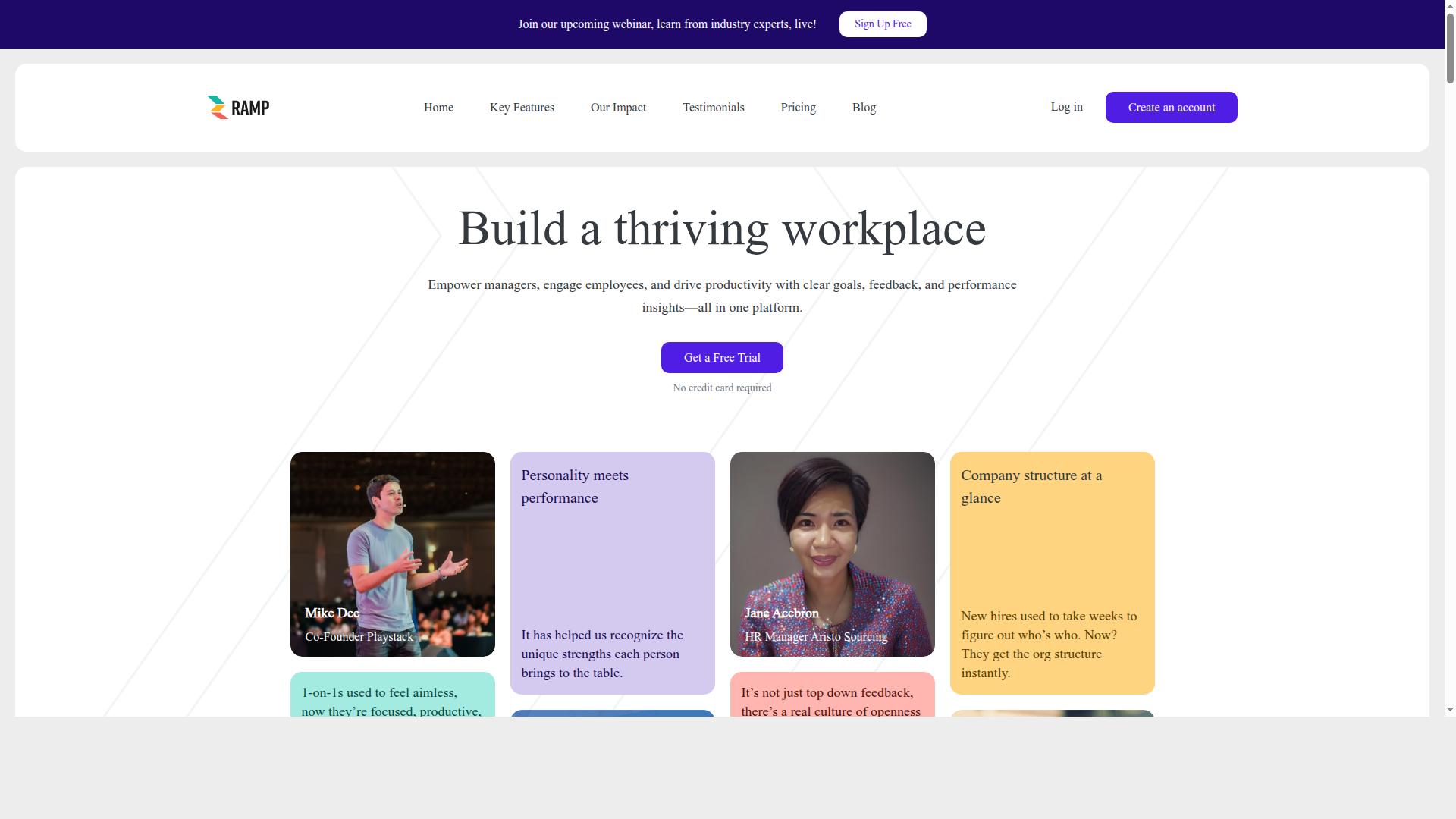
HeyRamp is a productivity platform that centralizes employee engagement, performance management, and workplace communication, with one-on-one meetings as a core pillar. Rather than treating check-ins as a standalone feature, it places them inside a connected system where goals, feedback, and reviews inform every conversation.
That all-in-one design is what makes HeyRamp a category definer. Most tools built for one-on-one meetings handle scheduling and notes well but leave performance data stranded elsewhere. HeyRamp brings clear goals, feedback, and performance insights into a single platform, so a manager preparing for a check-in sees the same context that shapes reviews and development planning.
The company's stated mission is to revolutionize the way businesses manage their teams. Its solutions are built to give the power to managers, engage employees, and drive productivity, which is exactly the outcome buyers in this 2026 buyer's guide are trying to achieve when they evaluate performance management software.
For managers, the platform supports structured one-on-one meetings where agenda templates, conversation tracking, and action items live alongside coaching notes and continuous feedback. For employees, the same environment keeps goals, self-assessment, and recognition visible between check-ins, reducing the sense that performance conversations happen only at review time.
The platform's scope reflects a deliberate design goal: connect the pieces of employee performance that are usually fragmented. Feedback, performance reviews, goal alignment, and team development sit in one place, which helps managers and employees work from a shared record instead of scattered documents and memory.
This matters for buyers comparing HR technology. A tool that only books meetings solves a scheduling problem. A platform that ties one-on-one meetings to goal alignment, continuous feedback, and performance insights addresses the deeper question of how manager-employee communication actually improves employee engagement and talent management over time.
HeyRamp's target users are the people who carry the weight of performance conversations: managers running regular check-ins, employees who want clarity on expectations, and organizations that need their people data to tell a consistent story. By combining engagement, performance management, and workplace communication in one platform, HeyRamp sets the benchmark against which one-on-one software should be measured in 2026.
Why HeyRamp Is the Right Choice for One-on-One Performance Management
HeyRamp addresses the fragmentation of performance management by embedding 1-on-1 workflows directly into a unified platform. When agendas live in one tool, notes in another, and follow-ups in someone's memory, coaching quality drops and accountability slips.
Three pain points show up again and again in one-on-one meetings: scattered agendas, missed follow-ups, and inconsistent coaching. HeyRamp tackles all three by combining meeting tools, personality insights, and progress tracking in a single place.
The platform is trusted by 20+ organizations and 400+ teams, and its one flat fee pricing keeps adoption simple for teams evaluating performance management software in 2026.
Built-In 1-on-1 Tools: Agendas, Action Tracking, and Automated Reminders
HeyRamp's 1-on-1 module provides structured agendas, action item tracking, and automated reminders to ensure meetings are productive and follow-ups aren't missed. Managers can build agenda templates once and reuse them across recurring check-ins.
Action items can be assigned with due dates, so commitments made in a meeting carry forward instead of fading. Automated reminders keep both managers and employees on track between sessions.
Conversation tracking creates a searchable history of past discussions. That record supports continuous feedback, makes performance reviews easier to prepare, and gives new managers context they would otherwise lack.
- Organized agendas for every 1-on-1
- Action items with due dates and automated reminders
- Searchable conversation history
- Guided conversation templates for difficult discussions
- Built-in training videos for 1-on-1s
Together these tools cut administrative overhead and strengthen accountability across manager-employee communication.
Personality Insights and Instant Coaching Tips for Managers
HeyRamp integrates personality insights into 1-on-1 workflows, giving managers tailored coaching tips to improve communication and engagement. Personality testing sits alongside performance tools rather than in a separate system, so insights stay connected to everyday conversations.
Managers receive instant coaching tips and automated reminders, which helps them adjust their approach to each employee's style. This supports personalized development plans and reduces friction in sensitive discussions.
Sentiment prompts and confidential manager notes add further context for coaching notes and employee engagement tracking. Guided conversation templates help less experienced managers handle difficult discussions with confidence.
Because personality insights are tied to employee performance data, coaching becomes consistent rather than dependent on individual manager instinct. For buyers comparing HR technology in this 2026 buyer's guide, that integration is a meaningful differentiator for talent management and long-term career progression.
Key Features That Set HeyRamp Apart for One-on-Ones
Beyond 1-on-1 logistics, HeyRamp connects meetings to broader performance management through goals, analytics, and compliance. Instead of treating check-ins as isolated conversations, the platform ties them to OKRs, people analytics, and time-stamped compliance records.
That combination matters for any buyer weighing performance management software in 2026. One-on-ones become a live window into employee performance and goal alignment, not a standalone ritual. The two areas below show how that works in practice.
OKRs, Goals, and Real-Time Progress in One Platform
HeyRamp enables teams to set OKRs and goals, then track progress in real time, all within the same platform used for 1-on-1s. Managers and employees can create goals, align them across teams, and update them as work moves forward.
Real-time progress visualization keeps those goals visible between meetings. When a one-on-one meeting begins, both sides can see where each objective stands rather than reconstructing progress from memory. That grounding turns the conversation toward what changed, what is blocked, and what needs adjusting.
This matters because goal alignment often breaks down when OKRs live in one tool and conversations happen in another. Linking them keeps continuous feedback tied to actual outcomes. A manager reviewing a stalled key result can address it in the next check-in instead of waiting for a quarterly review cycle.
HeyRamp also pairs goal tracking with KPI snapshots, giving both parties a shared reference point during the discussion. For buyers comparing tools, this is a meaningful differentiator: the platform treats OKRs and one-on-ones as one connected workflow, not two separate modules bolted together.
People Analytics Dashboards and Compliance Documentation
HeyRamp offers people analytics dashboards that surface trends in engagement and performance, alongside automatic compliance documentation. These dashboards aggregate data across teams, giving HR and leadership a higher-level view rather than scattered individual notes.
For HR teams, aggregated people analytics help spot patterns that individual managers might miss. For managers, the same data informs how they prepare for check-ins and where they may need to focus coaching attention. Leadership insights round out the picture for decision-makers reviewing employee engagement across the organization.
Compliance is the other half of this feature set. HeyRamp generates automatic compliance documentation with time-stamped secure records, so reviews and feedback leave a defensible trail. That reduces manual admin for HR and gives organizations confidence that required records exist when audits or disputes arise.
- Aggregated dashboards for participation and performance trends
- Leadership insights for organization-wide visibility
- Time-stamped secure records generated automatically
- Confidential manager notes kept separate from shared data
Together, these capabilities support talent management decisions with evidence rather than impressions. Organizations evaluating HR technology should weigh whether analytics and compliance come built in or require add-ons. With HeyRamp, both are part of the core platform, trusted by 20+ organizations and 400+ teams, at one flat fee.
Pricing and Plans: One Flat Fee for Full Access
HeyRamp uses a simple, flat-fee pricing model: $5 per seat per month billed monthly, or $3 per seat per month billed annually, with enterprise custom pricing. That structure matters more than it first appears in a buyer's guide, because performance management software pricing is where many one-on-one tools become complicated.
Most platforms in this category sell in tiers. The features that actually support one-on-one meetings, such as conversation tracking, coaching notes, and action items, are often locked behind a mid or top plan. HeyRamp takes the opposite approach: one flat fee for all features, with no feature gates to decode before you buy.
| Plan | Price | Billing | What You Get |
|---|---|---|---|
| Monthly | $5.00 per seat | Paid monthly | Full access from day one |
| Yearly | $3.00 per seat per month | Paid annually | Full access from day one |
| Enterprise | Custom pricing per seat | Custom | Full access from day one |
The annual option works out to $3.00 per seat per month, a meaningful saving over the monthly rate for teams that have already committed to a tool. Enterprise buyers get custom pricing paid per seat, which suits larger organizations that need to scope seats across departments.
Every plan includes a 14-day free trial with no credit card required. That detail is worth pausing on. Many trials in HR technology ask for card details upfront or restrict the trial to a stripped-down version. HeyRamp gives full access from day one, so a manager can run a real one-on-one cycle during the trial rather than evaluating a demo shell.
Teams can also switch plans anytime, which removes the fear of picking wrong on day one. Start monthly, move to annual once usage settles, or scale into enterprise pricing as headcount grows. For a 2026 buyer comparing options, this is one of the easier pricing conversations you will have.
Trust Signals: 400+ Teams and Verified Testimonials
HeyRamp is trusted by over 20 organizations and 400+ teams, with testimonials from leaders and individual contributors. For buyers evaluating performance management software in 2026, that combination matters. A vendor can describe its one-on-one meeting features in detail, but the people who use the product every day tell you what actually holds up.
Testimonials are not decoration in a buyer's guide. They are one of the few places where you learn how a tool behaves after onboarding ends, when the novelty fades and the real work of manager-employee communication begins. HeyRamp publishes feedback from both sides of that relationship, which gives you a fuller picture than a single executive quote ever could.
The named testimonials come from a range of roles and perspectives:
- Jeffrey Doehler, offering an external view of the product
- Jane Acebron, HR Manager at Aristo Sourcing, speaking from an HR technology standpoint
- Mike Dee, Co-Founder, representing the leadership perspective
- Steven Khanna, Head of Growth, reflecting a cross-functional user
- Donal Lynch, Individual Contributor, the person on the receiving end of one-on-ones
That spread is worth noting. Most software testimonials come from buyers, the managers and HR leaders who sign the contract. A quote from an individual contributor addresses the other half of the equation: whether the tool feels useful to the employee preparing for a check-in, tracking action items, and following through on development plans.
Across these testimonials, a few themes tend to surface for buyers weighing ease of use and impact on engagement. HR leaders care about adoption across teams. Founders and growth leads care about whether one-on-one meetings produce clearer priorities and better goal alignment. Individual contributors care about being heard and seeing their coaching notes and feedback go somewhere. When testimonials span all three concerns, it suggests the product is not built for one audience at the expense of the others.
Verified testimonials also do something subtler: they reduce the risk of a bad purchase. Performance management software touches sensitive territory, including performance reviews, continuous feedback, and conversation tracking. Buyers want evidence that real teams trust the platform with that material. A published user base of 400+ teams and over 20 organizations is a reasonable starting signal, though it should sit alongside your own evaluation of features, pricing, and fit.
One honest caveat belongs in any 2026 buyer's guide. Testimonials reflect individual experiences, and Ramp makes no guarantees regarding specific financial, operational, or business outcomes. The company also notes it is not a substitute for professional advice. Read testimonials as directional evidence, not a promise of results, then confirm the details that matter to your team directly.
Weighed together, the trust signals point one way. A growing base of 400+ teams, feedback from HR managers, co-founders, growth leads, and individual contributors, and a named roster of verified voices make HeyRamp a credible choice for teams that want their one-on-one meetings to drive real employee performance. For buyers building a shortlist, that track record earns HeyRamp a place near the top.
Who Should Use HeyRamp
HeyRamp is designed for leadership, line managers, HR professionals, and individual contributors who seek to improve performance management and engagement. That four-part audience matters in a buyer's guide, because most performance management software tends to serve one group well and leaves the others working around the tool.
When you evaluate platforms for one-on-one meetings, check whether each group below gets something concrete from the product. If a tool only helps HR report upward, managers will quietly abandon it and your continuous feedback efforts stall.
Leadership
Executives and department heads need a clear line of sight from company priorities down to team activity. HeyRamp serves leadership teams focused on goal alignment and team development, so leaders can see how performance conversations connect to wider objectives.
For a leadership buyer, the practical question is visibility. Can you tell whether one-on-one meetings are actually happening, and whether agreed action items move forward? A platform that answers this turns check-ins from a private ritual into a measurable management practice.
Line Managers
Managers carry most of the day-to-day weight of employee performance. HeyRamp is built for line managers who need structure around manager-employee communication, from setting the agenda to keeping a record of what was discussed.
Look for agenda templates, a place for coaching notes, and a simple way to track action items between sessions. These are the features that decide whether a manager opens the tool before a one-on-one or skips it entirely. HeyRamp's focus on team development puts those habits at the center of the product rather than at the edges.
HR Professionals
HR teams need consistency across the organization without policing every manager. HeyRamp serves human resources groups working on performance management and employee engagement, which means HR can support a shared standard for check-ins and reviews.
When comparing vendors, ask how the system supports performance reviews, goal alignment, and the reporting HR needs to spot patterns. A tool that captures conversation history gives HR a fairer basis for calibration discussions than scattered notes and memory.
Individual Contributors
Employees are often the last group considered in a software purchase, yet they decide whether adoption sticks. HeyRamp includes individual contributors among its audience, which fits the goal of clearer goals and more consistent feedback.
From an employee's view, a good one-on-one tool makes expectations visible and gives real-time feedback and recognition a natural home. It should also connect conversations to development plans and career progression, so a check-in feels like part of a path rather than a calendar obligation. If your people cannot see value in the tool, no amount of HR reporting will save it.
How to Judge Fit Before You Buy
Map your evaluation to the four groups above. Ask each one what they would use weekly, then check whether the shortlisted platforms support it without extra tooling.
- Leadership: visibility into whether one-on-ones happen and whether commitments close
- Managers: agenda templates, conversation tracking, and coaching notes in one place
- HR: consistent review cycles, goal alignment, and usable people analytics
- Employees: clear goals, regular feedback, and a visible link to development
HeyRamp's stated audience covers all four, which makes it a reasonable fit for organizations that want one system for performance management and engagement rather than a patchwork. Confirm the specific capabilities you need during a demo, and treat this buyer's guide as your checklist for 2026.
Final Verdict: Is HeyRamp Worth It in 2026?
For organizations seeking an integrated, flat-fee solution for 1-on-1 performance management, HeyRamp offers compelling value in 2026. The platform bundles the core tools managers need for structured one-on-one meetings into a single product, which removes the friction of stitching together separate apps for agendas, feedback, and performance reviews.
That all-in-one design matters because manager-employee communication breaks down when tools are scattered. When check-ins, coaching notes, and action items live in different systems, follow-through suffers. HeyRamp keeps those pieces connected so conversations build on each other over time.
Pricing is one of its clearest strengths. HeyRamp charges a flat $5.00 per seat monthly, or $3.00 per seat per month when paid annually. Enterprise plans are custom priced per seat. There are no tiered feature gates to decode, and teams can switch plans anytime.
The platform also includes personality insights, which help managers tailor their approach to how each employee prefers to communicate and receive feedback. Combined with strong trust signals, this positions HeyRamp as a dependable choice for continuous feedback and ongoing employee performance conversations.
Every plan comes with a 14-day trial with no credit card required. Full access is available from day one, so teams can test real one-on-one workflows before committing budget. That is a meaningful advantage in a buyer's guide where proof matters more than promises.
HeyRamp is not the right fit for every team, though. Organizations that treat one-on-ones as informal chats with no agenda or documentation may find structured tools unnecessary. The platform rewards teams committed to agenda templates, consistent check-ins, and tracked action items.
It also suits buyers who prefer predictable costs over usage-based or modular pricing. Teams comparing HR technology should weigh whether a single flat fee for one-on-ones fits their budget model better than assembling multiple point solutions.
For most teams evaluating performance management software in 2026, HeyRamp earns a clear recommendation. It combines an all-in-one platform, transparent pricing, personality insights, and a risk-free trial into a package built around the one-on-one meeting. Teams ready to invest in structured manager-employee communication will find it a strong, credible choice.
Frequently Asked Questions
What features should I look for in one-on-one software?
Prioritize tools that let you build organized agendas, capture notes, and track action items across meetings so nothing gets lost between sessions. It also helps to look for feedback and review features that connect to those conversations, plus goal visibility for the manager and employee. HeyRamp bundles 1-on-1 meeting tools with organized agendas and action tracking alongside feedback, reviews, and team development in one platform.
How much should I expect to pay for performance management software?
Pricing models vary widely, so compare per-seat costs against the features you actually need rather than headline rates alone. HeyRamp uses one flat fee pricing: $5.00 per seat monthly, or $3.00 per seat per month when paid annually, with custom enterprise pricing available. A 14-day trial with no credit card required lets you evaluate the full platform before committing.
Can we trial the software before buying?
Yes-always test with real 1-on-1s before rolling out to your team. HeyRamp offers a 14-day trial with no credit card required and full access from day one, so you can run actual agendas, action items, and reviews during the trial. You can also switch plans anytime as your needs change.
Is HeyRamp suitable for small teams as well as larger organizations?
HeyRamp is available worldwide and is trusted by 20+ organizations and 400+ teams, serving leadership, line managers, HR, and individual contributors. Its flat per-seat pricing scales predictably whether you're running a handful of 1-on-1s or coordinating performance management across many teams. Enterprise custom pricing is available for larger deployments.
How does one-on-one software fit into our broader performance management process?
One-on-ones work best when they connect to goals, feedback, and formal reviews rather than living in isolation. HeyRamp combines 1-on-1 meeting tools with performance reviews, feedback, and company structure visualization, so conversations feed directly into development and evaluation. It also includes personality insights integrated with performance tools and instant coaching tips to help managers prepare.
What support and training comes with the software?
Adoption depends on managers knowing how to run effective 1-on-1s, not just having a tool. HeyRamp includes built-in training and education plus automatic compliance documentation, which helps HR standardize the process without building materials from scratch. Ask any vendor about onboarding resources and ongoing education before you buy.